
How to Practice Shooting Accuracy in the Backyard
Improving shooting accuracy doesn’t require a full-size pitch or teammates — it requires intention, repetition, and the right setup. In a small backyard you can build focused routines that target placement, technique, and decision-making.
Start simple, measure progress, and upgrade tools as you go. For gear and ideas that suit backyard practice, check resources from Soccer Gear Scout to find suitable training options and accessories.
Why backyard practice works
Backyard sessions remove pressure and let you concentrate on fundamentals: consistent contact, body position, and visual targets. Short, frequent sessions will produce better results than occasional long ones because accuracy is a motor-skill learned through repetition.
Work on one focus per session (e.g., low-driven shots, far-post placement) so every rep reinforces the same exact movement and outcome.
Essential backyard equipment
Invest in a few versatile pieces so you can change drills quickly. A compact goal or target frame is the baseline; a rebounder gives you extra reps without chasing balls. Rebounders are compact and ideal for limited spaces — explore options under Soccer Rebounder Nets for different sizes and bounce characteristics that suit your yard.
Other useful items include cones, a marked shooting zone, and a range of balls (lighter balls for technique work, match ball for speed).
DIY targets and smart setups
Creating clear targets forces precision. Use cones, suspended cloth targets, or an area of the goal marked with tape. For a compact, multi-purpose rebound/target option that’s quick to set up and ideal for limited spaces, consider a product like the Soccer Baseball Rebounder Soccer Goal Net, which can double as a target and a return net.
Vary target size: start with large targets, then narrow them as accuracy improves. Mark specific “corner zones” so you have measurable goals: top-left, bottom-right, near-post, far-post.
Shooting mechanics and core drills
Accuracy starts with a repeatable technique. Key points: plant foot beside the ball, lean over the ball to keep shots low, strike with the proper part of the foot (instep for power, inside foot for placement), and follow through in the direction of the target.
Drills to build mechanics:
- Spot-to-spot finishing — place the ball at five spots just outside the box and aim at a single small target repeatedly.
- Controlled placement — slow approach, focus on foot contact and follow-through, 20 reps per side.
- One-touch placement — receive a pass and aim immediately at the target to simulate quick decision finishes.
For drills that simulate defenders and fixed-wall scenarios, a training aid like Soccer Training Mannequins can help you practice curved runs and bending shots around obstacles.
Repetition, returns, and solo training
To get high-volume reps in a small space use return equipment. Kick return trainers let you shoot, retrieve instantly, and shoot again without chasing the ball — this keeps intensity high and fatigue low. Check options under Soccer Kick Return Trainers to find models that suit your yard and shooting style.
Set a rep target (e.g., 100 quality shots per session) and log how many hit your target zones. Quality beats mindless volume: a successful rep is one where you executed technique and hit the target, not just a shot fired.
Build footwork and finishing angles
Most accurate shooters create space and the right angle before striking. Add simple combination drills that include a few quick touches, a change of direction, then a shot. Use small slalom setups or ladders to force quick feet before finishing.
Tools that improve close control and transitions to shot include Soccer Dribbling Trainers, which help you simulate defenders and practice the small touches that set up a precise finish.
Warm-up, conditioning, and agility
Accuracy suffers when muscles are cold. A focused warm-up improves consistency: dynamic stretches, short sprints, and mobility drills for hips and ankles. Integrate speed and reactive work so your body can reproduce accuracy at match pace.
Compact agility kits include ladders, cones, and mini-hurdles to build foot speed and coordination. For home conditioning and fast-feet drills, see Soccer Speed and Agility Sets, which bundle several useful tools for backyard sessions.
If you want a single warm-up/footwork tool that combines ladder drills with other elements, an Agility Ladder,Soccer Training Equi… product provides ladder and hurdle exercises to sharpen quickness before shooting practice.
Design progressive shooting sessions
Structure sessions so they build complexity and pressure gradually. Sample 30–45 minute session:
- Warm-up: 8–10 minutes mobility and ladder/agility work
- Technique block: 10 minutes slow, focused strikes to target
- Power/placement block: 10–15 minutes alternating power shots and placed shots
- Game-speed block: 10 minutes one-touch finishes, rebound shots, and timed sets
- Cool-down and notes: 5 minutes, record what improved and what needs work
Gradually increase pressure: narrow targets, reduce approach time, add a passive defender (a mannequin or cone wall) to force placement under constraint.
Checklist: Quick backyard shooting accuracy setup
- Designated shooting zone and marked target areas
- Goal or target frame (compact or rebound net)
- Ball set: training ball + match ball
- Cones for angles and mannequins for obstacles
- Return or rebound device to increase reps
- Agility tool for warm-up and quick-feet work
- Simple tracking: shot counts and target hits
FAQ
- How often should I practice shooting in the backyard? Aim for short, focused sessions 3–5 times per week rather than infrequent long sessions.
- How many reps per session are useful? Target 50–150 quality shots depending on intensity; prioritize technique over raw volume.
- Can rebounders damage my ball or my lawn? Most quality rebounders are ball-friendly; place them on a flat area and follow manufacturer guidance to protect your lawn and ball.
- How do I simulate goalkeeper pressure? Use mannequins to block angles and practice placing shots around them; that replicates decision-making under pressure.
- What’s the best way to track progress? Log the number of target hits vs attempts, note consistency by zone, and record occasional video to analyze technique.
Conclusion
Backyard shooting accuracy improves fastest when practice is intentional, structured, and repeatable. Start with clear targets, use equipment that increases reps (rebounders and return trainers), and progress from slow technical drills to game-speed finishing. A reliable routine and consistent tracking will turn backyard reps into on-field results.
Products Featured in This Article
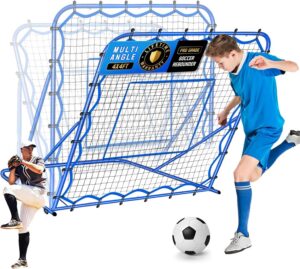
Soccer Baseball Rebounder Soccer Go…
Soccer Baseball Rebounder Net, Soccer Goal Net, Volleyball Softball Rebound Pitchback Net Quick-Switch Angle Training for…
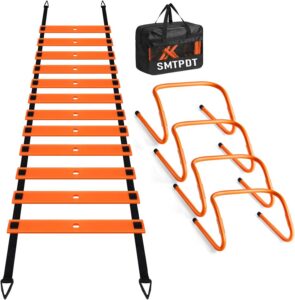
Agility Ladder,Soccer Training Equi…
Newly Upgraded Durable Hurdles–Stronger & More Reliable:We’ve upgraded our agility hurdles with premium materials and a…